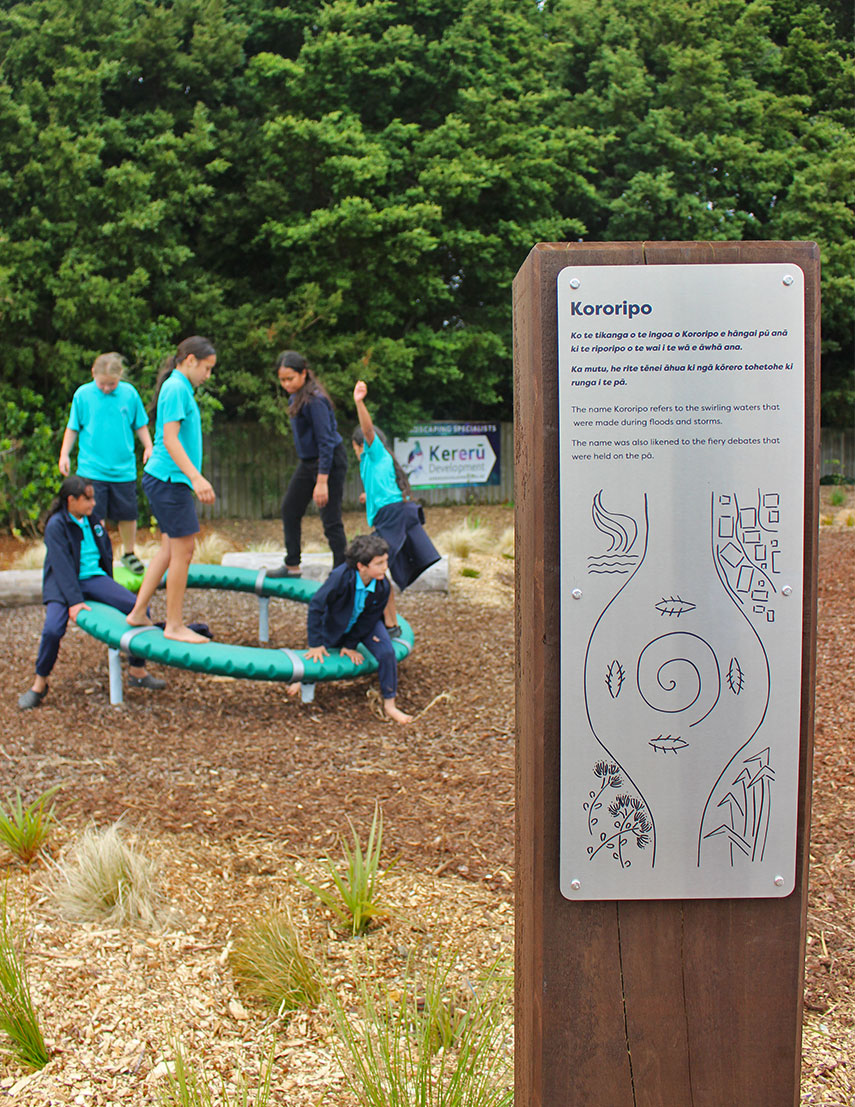
The vision for this space was shaped by the local community and led by Healthy Families Far North. Boffa Miskell supported the design process, including a Whānau Day to gather feedback and explore ideas. The result is a playspace that reflects the identity of place and people, drawing on rākau (wood), kōhatu (stone), wai (water) and whenua (land).
The playspace design is grounded in the whakataukī (proverb):
Te tika ka mōhio, te pono ka mārama, te pūrākau ka maumahara te ngākau
Tell me the facts and I’ll learn, tell me the truth and I’ll believe, tell me the story and it will live in my heart forever
Mana of our īngoa tangata and pūrākau as a method of ako (to learn and to teach) has the power to keep Māori values alive and can be created in various settings to better understand whakapapa and identity.
The kaupapa (guiding principle) celebrates ngā taonga tuku iho (traditional stories) through play and supports Te Whare Tapa Whā (physical, mental, social and spiritual wellbeing). Previously there was no dedicated space for tamariki (children) and whānau (families) to play safely. Children would often play in long grass or leap from storage containers, posing significant health and safety risks.
Design challenges included integrating a stormwater drain that runs through the site and protecting mature tōtara trees, which were retained and woven into the layout. The space is accessible and inclusive, offering opportunities for all ages to connect, play and learn.