Parakiore: Insights from a decade of design and delivery
9 February 2026
SHARE


Landscape architects Megan Walker and Hamish Cochrane reflect on their long involvement in Christchurch’s Parakiore Recreation and Sport Centre, one of the city’s most significant post‑earthquake public facilities.
Q: What was your role in the Metro Sports | Parakiore project?
Megan Walker: I joined Boffa Miskell as a graduate Landscape Architect and worked on the project from the Masterplan in 2013 to Construction Documentation in 2018. My role included design development: site analysis, structuring the site, spatial layout, cultural narrative, movement framework, water‑sensitive design response, and levels strategy.
I supported the team with plans, sketches, 3D visualisations, and graphic documentation. I collaborated with Civil and Architectural teams for an integrated design response.
Hamish Cochrane: Like Megan, it was one of the first projects I worked on when I joined Boffa Miskell as a graduate in 2017. The team was detailing a design developed over previous years, and my role included completing the documentation set — 272 sheets of drawings, details, and planting plans.
My involvement then shifted to construction observation. I was on‑site weekly from 2022 to 2025, observing works, advising the project management team on alignment with our documents, and resolving site constraints.
Q: What’s your favourite memory, or the best thing you’ll take away from the project?
Megan: This was the first significant project I worked on after University, and I knew it would be valuable to see a project through from urban design master plan to detailed design.
A highlight of the early concept phase was the creativity — finding ways to inject fun and playfulness to encourage activity. This led to ideas like colourful climbing poles inspired by ‘Ninja Warrior’, and the giant tetherball inviting impromptu play.
Working with mana whenua on the cultural narrative connected the design to the pre‑urbanised landscape. The interpretation of Raupō creek inspired imagining the hydroslides as a whirl of eels: black with ‘wrinkles’ where they bend, net‑like fencing through the landscape, and poles with colour tops like raupō seed heads.
We also drew on the site’s 150‑year history as the Canterbury Draft brewery. Locating the hydroslides on the northeast corner referenced the brewing tanks and pipework that had been a landmark. We wanted to maintain continuity as the city changed during the rebuild.
It’s amazing to have been involved from the Blueprint through to Opening Day. It’s been a huge opportunity.
Hamish: Opening day was a highlight. After being invested in the physical outcome for almost three years, it was rewarding to see people using and enjoying the space. All the hard work, late nights, imperfections, and rain‑drenched site inspections fell away when I saw the facility working as intended.
It was gratifying to see smaller details come together and to see parts of the site I’d thought about for years being used the way I’d hoped they would be.
Q: In terms of your own part of the project, is there anything you’d change; or would have done differently?
Hamish: There are always aspects you learn from and would do differently next time. One of the benefits of this project was the long construction programme. With so much happening across the wider build, it gave the landscape works a real opportunity to identify and resolve issues as they arose.
The team was strong at flagging potential problems early, allowing a whole‑team approach to getting the best possible outcome before anything was built on site.
Megan: From the outset, we knew the importance of Parakiore for Christchurch and as a milestone in our careers, and we did the best we could throughout all phases. Joining as graduates at different stages meant long hours and learning quickly. It was pushing the limits of what we were able to do within our own capability; and more broadly, for the whole team as a design practice. We are really proud of the result.
Q: What was the biggest challenge for you?
Megan: The design shifted four or five times, particularly pre‑construction, and each stage came with a new brief. So, you’d go through and read what it was and do a gap identification, like: “Oh, okay, now we have this, but we don't have that anymore….”
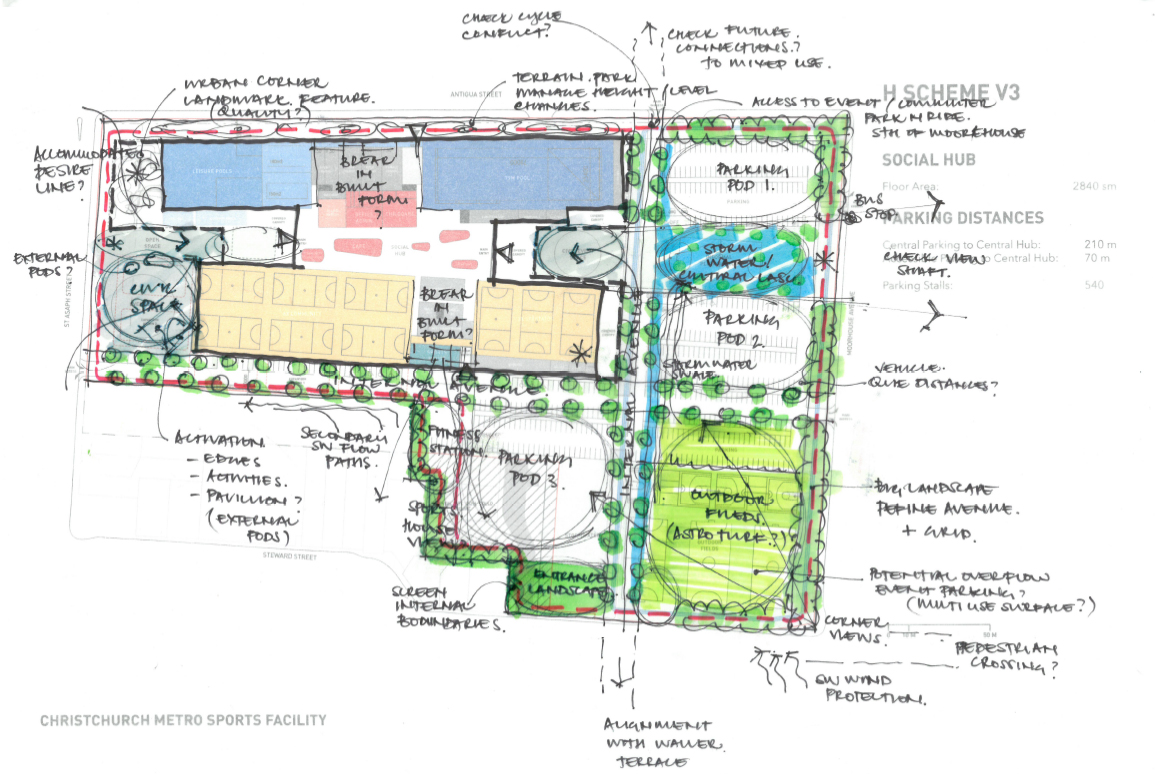
The site extent changed; the building form changed from a long building to the H shape; the brief changed from outdoor courts to increased parking; all of it affected the landscape and budget. This required us to be nimble and redesign the site any number of times, while remaining true to the core vision and principles.
Hamish: Another challenge given the length of construction, was changing personnel across other companies. Our team was relatively consistent throughout the build and having that holistic overview of the site and the landscape approach meant we stayed closely invested in the wider team’s direction.
It was keeping track of seven years of construction updates, maintaining relationships as project teams changed, and bringing new people up to speed with the original landscape design intent.
Q: How did you overcome those challenges?
Hamish: Referring back to our design reports helped re‑anchor decision‑making to the design that had been developed many years earlier. Good systems and consistency helped: clear records, revisiting documentation, and walking new team members through key details.
On‑going site presence on a weekly basis also helped. It meant we could catch issues early, respond quickly, and work through constraints with the contractor before they became bigger problems
Megan: Working together. The building floor level sits more than 2m above the street due to engineering requirements, and that created challenges as one of the design principles was that Parakiore would be Universal Accessibility, with everyone using the same route to access the building, without separation due to physical ability.
Achieving this required collaboration in the wider team from the very earliest stages of site design to ensure that there was sufficient space to gently slope the ground levels to all entrances, with the aim of avoiding steps or ramps with handrails. We succeeded, and the result is a site where everyone uses the same spacious, welcoming pathway to access the building. We were delighted that the first formal event held at the facility was the New Zealand Special Olympics Summer Games.
Q: What other positive achievements or benefits have come from our work on Parakiore?
Hamish: This was one of the design team's first BIM projects. We fully 3D‑modelled the landscape and produced drawings from a coordinated model. Thirteen years ago, there was no BIM process at Boffa Miskell. Parakiore and similar projects became foundation stones for the process we use now.
BIM is a really powerful tool to use, because, as we keep stepping through the process, we had this digital model that was fairly easy to update; it kept all of the design intent behind the full extent of the design within our current drawings, it made it really easy to see, like, where we were trying to do certain things in different parts, so, and it made it really easy to be able to communicate that.
We spent time on levels design and 3D elements like retaining walls and furniture, building a shared understanding of how everything looked and worked. VR helped us check the design in the field.
Maintaining one model kept continuity from 2016 to 2025 and enabled efficient documentation. We could test complex systems digitally before construction, confirming the design worked and checking for clashes.
Megan: Parakiore, originally called Metro Sports, was one of the Blueprint’s Anchor Projects. It’s the last to be completed and already it's contributing positively to the city. It is impressive, full of energy, and a symbolic milestone in the central city’s post‑earthquake recovery.
Q: How are you seeing people using the space, and is that aligning with the design intention?
Megan: It’s busy; people move through the central social space, walking and mingling, and it feels like an internal street. So, it's doing everything we wanted it to do. It feels open, welcoming, and light. The carpark is usually full, but you can find a park. And you do see people coming in from the north a lot, riding in with their bikes or walking in from town.
Hamish: What Megan says about people mingling through that main corridor is one of the things that I’ve seen on the few days that I've walked through, and it’s really cool. On opening day, they had some of the athletes there and watching them head up to High Performance Sport to start their training, or just walking through and seeing people playing on the courts is really engaging. Seeing people playing sports in a great public facility that I had a role in creating is just a very good feeling.


